
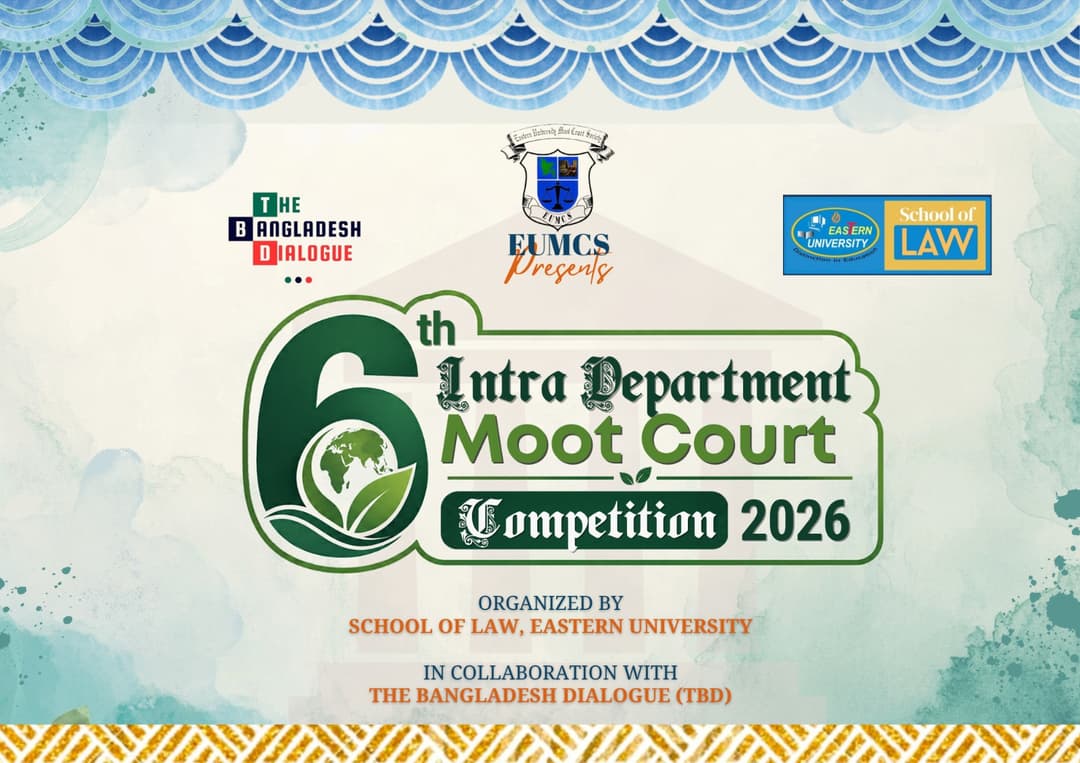
The School of Law, Eastern University, and the Eastern University Moot Court Society (EUMCS) are set to organize EUMCS presents 6th Intra-Department Moot Court Competition, 2026, which will be held on 16 and 17 October 2026 at the Eastern University campus in Ashulia, Dhaka. This year's edition is particularly significant, as it is held in collaboration with The Bangladesh Dialogue (TBD), a leading civil society-led policy think tank in Bangladesh for the first time. The competition has drawn a record 26 participating teams, the highest in its history, reflecting its growing reputation as one of the most anticipated mooting events from one of the premier law schools in the country.
The event will bring together an exceptional panel of adjudicators, including legal practitioners, serving judges, academicians, policy researchers, and accomplished former mooters. The final round will be adjudicated by Mr. Justice Md. Rezaul Haque, Judge, Appellate Division, Supreme Court of Bangladesh, alongside Barrister Aneek R. Haque, Additional Attorney General. Their presence underscores the competition's standing as a leading platform for nurturing Bangladesh's next generation of legal advocates.
The 2026 moot problem presents a fictional dispute between two sovereign states, engaging participants with complex and contemporary questions of International Law. The competition explores themes drawn from International Environmental Law, International Watercourse Law, the Law of Treaties, and Customary International Law. Participants will grapple with issues such as the legal interest of states to enforce obligations owed to the international community, the utilization of shared watercourses in conflict with environmental requirements, transboundary environmental harm, and foundational principles including the no harm principle and the precautionary principle.
These themes carry profound relevance in the present times, as the world confronts escalating climate crises, deepening water scarcity, and the increasingly urgent need for robust legal frameworks to govern transboundary natural resources. For Bangladesh, a nation acutely vulnerable to the effects of climate change and dependent on shared river systems, these questions are not merely academic rather they sit at the heart of the country's environmental security and diplomatic priorities.
The collaboration with The Bangladesh Dialogue signals a shared vision of bridging legal education with policy research, ensuring that the lawyers of tomorrow are equipped with analytical depth and advocacy skills required to shape thoughtful, evidence-based solutions to national and global problems. The EUMCS expresses its sincere gratitude to The Bangladesh Dialogue for its partnership, to the distinguished adjudicators for their invaluable time and expertise, and to all participating teams for their dedication and rigor. The Society remains committed to advancing mooting excellence at Eastern University and to fostering a culture of legal scholarship, advocacy, and professional integrity among the law students of Bangladesh.
Loading...